You've got a website. It looks the part. Clean design, good copy, maybe even a decent amount of traffic. But the leads aren't coming in the way you expected and you're not entirely sure why. The answer is almost never the design. It's the structure underneath it.
Most websites are built starting from how they look: the colours, the fonts and the layout. While those things matter, they're the last decision that should be made not the first. When the structure isn't right, no amount of visual polish will move the needle. You end up with a beautiful website that quietly leaks customers at every stage.
The good news is that this is a solvable problem and it starts with five things.
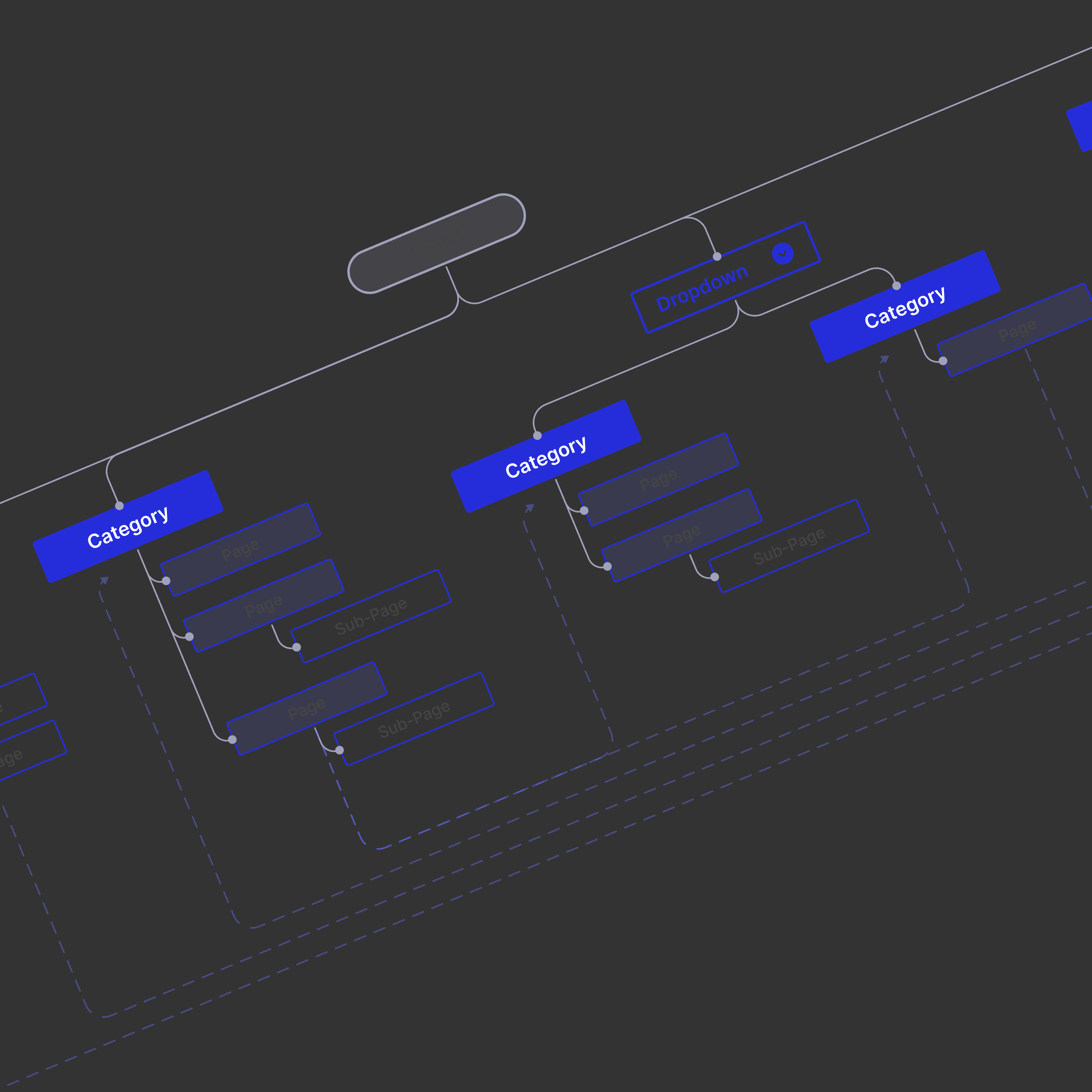
1. A sitemap that reflects how your customers think, not how your business is organised
Most sitemaps are built from the inside out structured around departments, products or internal terminology that makes sense to the team but leaves customers guessing. A sitemap built for conversion starts with your audience's search intent. What are they actually looking for? What language do they use to describe their problem? That's the architecture your navigation should reflect.
A top nav that reads Home, Features, Pricing, About Us, Contact isn't wrong but it's generic. It's not built from an understanding of how your specific customer moves through a decision. Small moments of confusion, repeated across a website, add up. It's death by a thousand paper cuts.
2. The flows you want customers to take
Once someone lands on your site, where do you want them to go? Most websites leave this to chance. A deliberate flow maps the path from first visit to conversion, understanding where customers enter, what they need to see at each stage and what the next logical step is. Without this you're hoping customers find their own way. Most won't.
3. Content structured around awareness, not assumption
Someone who just discovered they have a problem needs something very different from someone who's ready to buy. Your content needs to speak to both and everyone in between. Structure your pages around where a customer is in their thinking not just what you want to tell them. This is what turns a website into a journey rather than a brochure.
4. A style guide that makes navigation effortless
This is where the visual design earns its place. A style guide isn't about making things look beautiful, it's about removing friction. Consistent visual cues, clear hierarchy, and intentional use of colour and type help customers move through a site without having to think too hard. The best designed websites are the ones where the design is invisible. The customer just flows.
5. A way to test what's actually happening
This is the piece most businesses skip and it's the one that compounds everything else. Testing whether that's heatmaps, session recordings, A/B tests or simply watching a real customer use your site shows you where the leaks are. It turns guesswork into decisions. And it means every iteration of your website is smarter than the last.
These five things together are what a design system actually is.
Not a style guide. Not a component library. A design system is the distillation of all these decisions: the research, the structure, the flows and the testing into something that can be built on, improved and understood by everyone working on the business.
When that foundation exists, the visual layer has something to sit on. When it doesn't, you're decorating a leaky bucket.
A thought on AI
Tools like AI can shortcut a lot of the execution generating pages, writing copy, building style guides in minutes and that's genuinely useful. But AI makes average decisions based on average inputs. It doesn't know your customers, your context or the specific problem your business solves. Hand it the structural decisions and you get a website that looks like everyone else's, optimised for no one in particular. The research, the flows, the testing that's the work that requires human understanding. AI can help you build faster once you know what you're building towards. It can't tell you what to build.
Before changing the design, ask whether the structure is right. Is the navigation built around how your customers think? Are the flows intentional? Is the content meeting people where they are? Is there a way to measure what's working?
Most of the time, the answer to at least one of those is no. And that's where the real work and the real results begin.
Let's find where your website is losing people.
I work with founders to find where their website is losing people and build the structure to convert them.